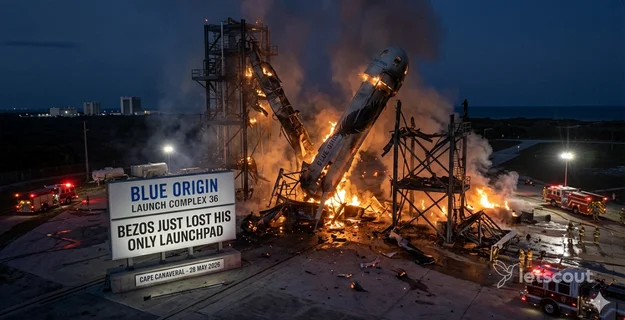
Space is hard. Jeff Bezos has known that longer than most. What he probably did not expect was to watch his 321-foot rocket turn into a fireball while it was still bolted to the ground.
On 28 May 2026, around 9pm local time, New Glenn's seven BE-4 engines lit up for what was supposed to be a routine static fire test at Launch Complex 36, Cape Canaveral. Something went wrong in the first seconds of ignition. The whole vehicle came apart. The fireball was visible for miles across Brevard County. Homes shook. Bezos went online to say he was relieved no one was injured, which was, all things considered, the only good news available.
New Glenn had already been grounded once this year. In April, its third flight left an AST SpaceMobile satellite in the wrong orbit after an upper stage engine failure. The FAA stepped in, Blue Origin ran its investigation, and the 28 May static fire was meant to draw a line under all of that — a final sign-off before a June launch carrying the first 48 Amazon Leo internet satellites. That launch would have been the start of a 24-mission contract. Instead, it is the worst thing that has ever happened to a company Bezos has spent 26 years and more than $10 billion building.
He has described Blue Origin, on more than one occasion, as potentially the most important work of his life. Right now it has no rocket and no operational launchpad. Sorting out what that actually means takes a bit of unpacking.
One Pad, No Backup, and a Very Long Queue of Commitments
The thing that makes this explosion so consequential is not the rocket. Rockets can be built. It is the ground.
Launch Complex 36 at Cape Canaveral Space Force Station is Blue Origin's only orbital launch site. There is not a second one. The explosion did not just destroy the vehicle sitting on top of it. It severely damaged the launch mount, the umbilical connections, the lightning tower, and the supporting infrastructure below. People familiar with launchpad reconstruction timelines have put the rebuild somewhere between 12 and 24 months, though Blue Origin has not confirmed anything. The FAA has opened an investigation and New Glenn is grounded for the indefinite future.
Meanwhile, Blue Origin had made some pretty significant promises about what that pad was going to do.
Amazon had signed Blue Origin up for 24 New Glenn launches to deploy its Leo constellation, the company's answer to Starlink. The fourth flight — the one that became the explosion — was supposed to be the first of those 24. It would have carried 48 satellites. None of them were on board during the test, which is something, but the entire launch manifest is now suspended with no return-to-flight date. Starlink is already at over 5,500 satellites in orbit. Amazon Leo is nowhere near that. The gap just got considerably wider.
NASA is now doing its own quiet maths. Blue Origin holds a $3.4 billion contract to build the Blue Moon Mark 2 crewed lunar lander for the Artemis 4 mission, which is targeting a Moon landing in 2028. That lander launches on New Glenn. Two days before the explosion, NASA had also just handed Blue Origin a $188 million contract to deliver lunar terrain vehicles to the Moon's south pole, again using the Blue Moon lander, again on New Glenn. The agency's administrator sent a memo to staff acknowledging the obvious. The Space Policy Institute's John Logsdon told Time the explosion "certainly throws a monkey wrench in the Artemis schedule" — and noted the schedule was probably already slipping before any of this happened.
The Space Force, to its credit, did not publicly panic. It announced a task order for a New Glenn national security mission in the 2027 to 2028 window while the launchpad was still smoking. Whether that timeline holds is a different matter.
The Money Behind the Machine
Blue Origin is private. It has never raised a proper outside funding round, never filed for an IPO, never had to sit across the table from investors and justify its numbers. Bezos has been both the owner and the bank since he founded the company in 2000, funding it by selling Amazon shares. His total personal investment is estimated at over $10 billion. The company's valuation, according to industry analysts who are largely working from the outside, sits somewhere between $50 billion and $100 billion. There is no public data to verify that either way.
What is known: Amazon paid Blue Origin roughly $1.8 billion in 2025 under satellite launch agreements for Project Kuiper. So the company Bezos founded to fund the rocket company is now also the rocket company's biggest customer. The circularity there is worth noting when you are trying to understand what the blast actually cost.
Six weeks before the explosion, the Financial Times reported that Blue Origin was exploring outside investment for the first time. The company was apparently looking at what it would take to bring in external capital to cover expanded manufacturing, new launch facilities, and the relentless cost of competing with SpaceX for government contracts. That conversation was happening from a position of some momentum: New Glenn had flown three times, the booster had landed twice, and there were big NASA contracts in hand.
That is not the conversation Blue Origin is now walking into. A company that just suffered its most catastrophic failure, with its only launch site out of commission and its manifest frozen, going to outside investors for the first time is going to hear a very different set of questions. The valuation that emerges from that process, if it happens, will be the first real independent pricing of an asset Bezos has never had to put a defensible number on.
Bezos's portfolio outside of Blue Origin is worth knowing. He co-founded Prometheus, an AI startup, in November 2025 alongside former Google X executive Vik Bajaj. In June 2026, Prometheus closed a $12 billion Series B, valuing the company at around $41 billion. Early stage, yes, but the kind of early stage that gets serious attention fast. He also still owns The Washington Post, which is currently cutting about a third of its staff and is not anybody's idea of a growth engine. His family office has stakes in over 90 companies across biotech, energy, and tech. None of them are Blue Origin.
The point is that for the first time in a long while, Bezos has somewhere else credible to put his attention. Prometheus is genuinely interesting. The rocket company is, at least for the next year or more, a rebuild project.
What to Watch From Here
Nobody should write Blue Origin off. SpaceX's Starship has failed repeatedly and is still the most watched rocket programme on the planet. Aerospace runs on a different clock to software startups, and people who called New Glenn finished after the third flight's satellite failure would have looked foolish if NG-4 had gone cleanly. It did not, but the broader point stands.
The FAA investigation into a launchpad explosion is more involved than reviewing a flight anomaly. That process alone will shape the return-to-flight timeline more than anything Blue Origin does internally. Watch for the preliminary findings, which tend to come out three to six months in.
Watch Amazon's next move on Leo. With New Glenn grounded, Amazon has to think harder about how it uses SpaceX's Falcon 9 and Falcon Heavy for its own constellation deployments. The company that Bezos built Amazon to outlast is now the most important logistics partner Amazon Leo has. That is an awkward position that gets more awkward the longer the pad stays dark.
Watch the outside investment talks. If Blue Origin raises its first proper external round, the valuation will be the most closely scrutinised number in private aerospace this year. It will also tell you how much the explosion actually cost in terms of market confidence, which is harder to measure than physical damage but arguably more important.
Watch Prometheus. That is where Bezos's energy appears to be going, and with $41 billion in valuation after one funding round, the AI research and enterprise community is clearly taking it seriously. If Blue Origin is in a holding pattern, Prometheus is the live wire.
Bezos is worth somewhere between $221 billion and $241 billion right now. He can rebuild the launchpad. The question nobody is asking loudly enough is what he rebuilds it for — and whether the project that was supposed to be his most important long-term venture still holds that position in his own mind when he is also running a fast-moving AI company and watching his satellite constellation fall further behind Starlink every month.
The fireball was the moment everyone noticed. The next 18 months are where it actually gets decided.
Blue Origin, New Glenn, Prometheus, and the full commercial space and AI ecosystem are tracked on Letscout. If this is the space you operate in, the directory is where you start.